Welcome to the official digital gateway of the Democratic Republic of Timor-Leste. As the 11th member of ASEAN and a nation of immense potential, Timor-Leste is committed to fostering strong bilateral ties with Japan through transparency, sustainable economic growth, and vibrant cultural exchange.
Timor-Leste, officially the Democratic Republic of Timor-Leste (RDTL), is situated at the heart of the maritime crossroads between Southeast Asia and the Pacific. With a capital city in Dili and a land area of $14,874\text{ km}^2$, our nation is home to a dynamic population of approximately 1.45 million people. Our identity is uniquely shaped by our official languages, Tetum and Portuguese, while English and Indonesian remain vital in our professional and commercial sectors.
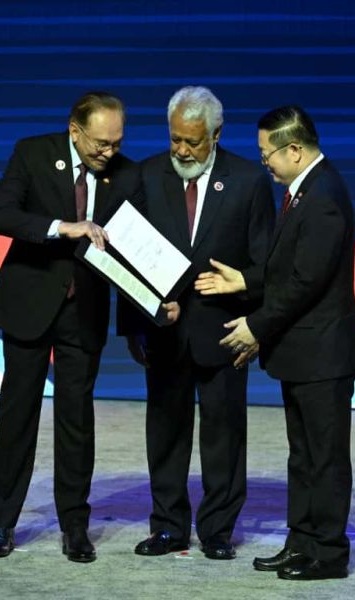
As one of Asia’s most vibrant and stable democracies, Timor-Leste operates under a semi-presidential system led by H.E. President José Ramos-Horta and H.E. Prime Minister Kay Rala Xanana Gusmão. A milestone in our national journey was reached in 2026, as Timor-Leste officially integrated as a Full Member of the Association of Southeast Asian Nations (ASEAN), harmonizing our regulatory frameworks with regional and global standards.
Currently, our national “Strategic Development Plan 2011–2030” is in its peak phase, prioritizing economic diversification and high-quality infrastructure. In the energy sector, we continue to advance the Greater Sunrise gas project while expanding into renewable energy sources. Agriculture remains a cornerstone of our exports, with Organic Timor Coffee (Arabica) enjoying significant prestige and demand in the Japanese market.
To support modern commerce, we have leveraged the Tibari Bay Port and our newly operational Submarine Fiber-Optic Cable, ensuring high-speed digital connectivity for global partners. Furthermore, our “Blue Economy” initiative promotes sustainable fisheries and maritime tourism within the biodiverse Coral Triangle, offering untapped potential for strategic investment.
The friendship between Timor-Leste and Japan is a cornerstone of our foreign policy. This partnership is exemplified by our deep cooperation with JICA on critical infrastructure, including the modernization of Dili International Airport and our national road networks. Beyond physical assets, we prioritize human capital through the Technical Intern Training Program (TITP), which allows Timorese citizens to learn from Japan’s industrial excellence. Sharing the same time zone (UTC+9) further facilitates seamless communication and cultural exchange between our two nations.
Timor-Leste offers a rare cultural synthesis of indigenous Austronesian traditions and Portuguese heritage. As a predominantly Roman Catholic nation, our social life is enriched by deep-rooted spiritual festivals. Our national pride, the Tais (traditional hand-woven textile), is recognized by UNESCO as an Intangible Cultural Heritage, symbolizing our history and artisanal skill. For global travelers, Atauro Island provides world-class eco-tourism and diving experiences, scientifically proven to host the highest marine biodiversity on Earth.
Our journey toward 2030 is anchored in three core pillars: reducing reliance on the Petroleum Fund through private sector growth, investing in the education and health of our youth, and serving as a proactive regional bridge between Southeast Asia and the Pacific.
For inquiries regarding investment opportunities, visa requirements, or bilateral cooperation, please contact our mission:
Embassy of the Democratic Republic of Timor-Leste in Tokyo
Address: 1-8-9 Fujimi, Chiyoda-ku, Tokyo 102-0071, Japan
Telephone: +81-3-3238-0210